Quiet Efficiency: How Japanese Logistics Intelligence Is Arming French Retailers in America's E-Commerce Battle
For years, the conventional wisdom in American retail held that heritage and quality were sufficient armor against the relentless efficiency of platform-driven commerce. French businesses, in particular, leaned heavily on provenance — the story of the vineyard, the lineage of the fromagerie, the hand-stitched detail on the leather goods. But as consumer expectations for delivery speed and order accuracy have hardened into baseline requirements rather than pleasant surprises, that armor has shown its gaps.
The businesses now finding a credible answer are not necessarily those with the deepest marketing budgets or the most recognizable labels. Increasingly, they are the ones that have looked eastward — toward Japanese logistics methodology — to solve a problem that French savoir-faire alone could not.
The Pressure That Reframed the Problem
The American e-commerce environment has matured into something French retailers did not fully anticipate when they entered the market through traditional wholesale and boutique channels. The dominance of next-day and same-day delivery norms, driven largely by Amazon's infrastructure, has created a consumer expectation that treats two-day shipping not as a premium offering but as a minimum standard.
For a French wine importer managing temperature-sensitive inventory across multiple US time zones, or a luxury skincare brand balancing small-batch production with unpredictable demand spikes, this expectation poses an existential logistical challenge. The cost of warehousing in multiple states, the complexity of compliance with varying alcohol distribution laws, and the reputational risk of a mishandled shipment all compound the pressure.
It was within this environment that a growing number of French-affiliated businesses in the US began to study, and in several cases directly partner with, Japanese logistics operators and platform developers who had spent decades solving analogous problems in a domestic market defined by precision, density, and unforgiving service standards.
What Japanese Logistics Brings to the Table
Japanese supply chain culture is built on principles that translate remarkably well to the high-stakes requirements of premium French goods. The concept of monozukuri — the disciplined art of making things — extends in Japanese business culture well beyond manufacturing into the handling, storage, and delivery of products. Temperature control, packaging integrity, delivery window accuracy, and last-mile reliability are treated not as logistical details but as expressions of respect for the product and the customer.
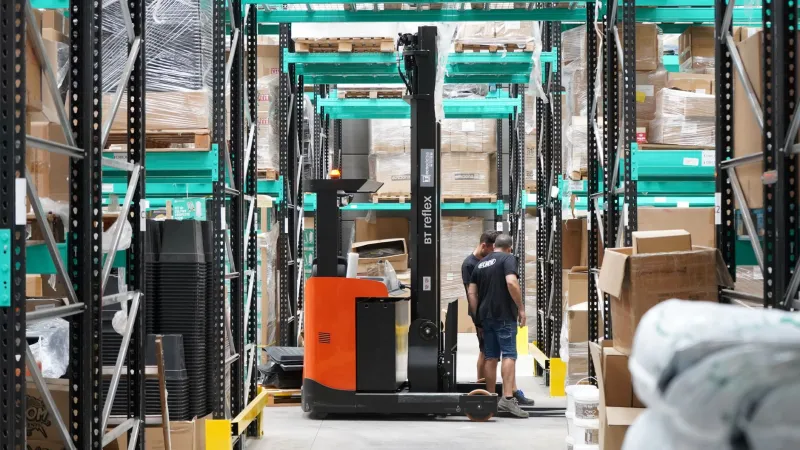
Several Japanese third-party logistics providers have established US operations specifically targeting the premium import segment, and French businesses have been among their most receptive clients. These operators typically offer multi-node fulfillment networks with real-time inventory visibility, carrier-agnostic routing that selects the optimal delivery method based on product type and destination, and returns processing systems designed to preserve brand perception even when a transaction goes wrong.
For French wine importers, the appeal is immediate. Temperature-monitored fulfillment centers operated by Japanese logistics partners have enabled smaller importers to offer reliable nationwide delivery without the capital expenditure of building proprietary cold-chain infrastructure. One importer of Burgundy and Rhône Valley wines, operating out of the Mid-Atlantic region, reduced average delivery times by nearly forty percent after transitioning its direct-to-consumer fulfillment to a Japanese-managed warehouse network with nodes in New Jersey, Texas, and California.
Brand Identity as a Non-Negotiable Constraint
What distinguishes the French adoption of Japanese logistics from a simple operational upgrade is the insistence that efficiency must never come at the cost of brand expression. This is where the partnership becomes genuinely interesting from a commercial standpoint.
Japanese logistics operators, particularly those serving the luxury and artisan import segment, have developed a sophisticated understanding of unboxing experience as a brand touchpoint. Packaging protocols that mirror the careful presentation standards of French retail — tissue paper folded with geometric precision, handwritten cards inserted at a specific angle, secondary packaging that communicates restraint rather than excess — are built into fulfillment workflows as standard operating procedure rather than custom requests.
A Provençal olive oil and condiment producer selling through a subscription model in the US reported that its customer satisfaction scores improved not only on delivery speed metrics but on packaging quality ratings after shifting to a Japanese-run fulfillment center. The operator had developed internal quality checklists for artisan food products that aligned closely with the brand's own presentation standards, reducing the friction that often emerges when premium brands outsource physical fulfillment.
The Technology Layer
Beyond physical logistics, Japanese e-commerce technology firms have developed inventory management and demand-forecasting platforms that are finding adoption among French businesses in the US. These systems, refined in Japan's hyper-competitive retail environment, offer predictive reordering algorithms that account for seasonal demand patterns, promotional cycles, and regional consumption trends.
For a French luxury goods retailer managing a catalog of scarce, seasonally restocked items — think limited-edition leather accessories or small-production wines — the ability to anticipate demand at the SKU level and position inventory accordingly across a distributed warehouse network represents a meaningful competitive advantage. Several such retailers operating in New York, Los Angeles, and Chicago have integrated Japanese-developed platforms with their existing Shopify or Magento storefronts through API connections, gaining forecasting capability without replacing their front-end infrastructure.
The data discipline embedded in these platforms also surfaces insights that French businesses have historically underutilized. Granular delivery performance data, return reason analysis, and regional conversion metrics are presented in dashboard formats that support rapid operational decisions — a style of business intelligence that complements the structured, detail-oriented management culture of many French enterprises.
A Competitive Posture, Not a Compromise
It would be a misreading of this trend to characterize French adoption of Japanese logistics as a concession to the Amazon model. The goal is not to replicate platform commerce but to neutralize its most damaging competitive advantages while preserving the distinctiveness that French brands have spent decades building in the American market.
Japanese logistics methodology offers a path to that neutralization precisely because it is not oriented toward volume and speed as ends in themselves. Its foundational concern is reliability — the elimination of failure at every stage of the customer journey. For French businesses whose reputation depends on the integrity of each individual transaction, that orientation is not a foreign concept but a familiar one expressed through different operational language.
The businesses that are navigating this convergence most successfully are those that have treated Japanese logistics not as a vendor relationship but as a strategic discipline to internalize. They are studying the underlying principles, training their own operations teams in the methodology, and building internal standards that reflect a genuine synthesis of French product philosophy and Japanese process rigor.
In America's unforgiving e-commerce landscape, that synthesis may prove to be one of the more durable competitive advantages available to businesses that refuse to choose between excellence and efficiency.